
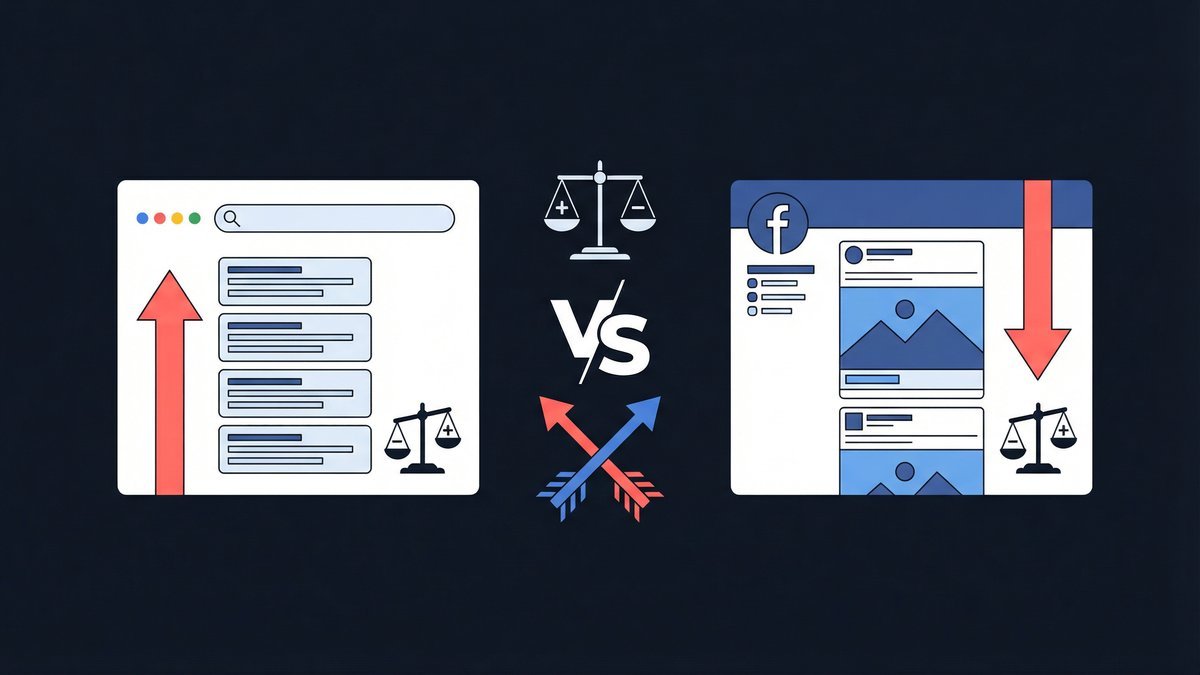
Choosing the right advertising platform is crucial for maximizing your marketing budget. Google Ads and Meta Ads (formerly Facebook Ads) dominate the digital ad space but serve different purposes and audiences. Understanding their differences ensures you invest where it matters most.
This article compares Google Ads vs Meta Ads focusing on user intent, costs, ROI, and sector-specific case studies to help marketers from Tunisia to Belgium make an informed decision.
Understanding User Intent: Google Ads vs Meta Ads
Google Ads primarily targets users with high purchase intent. Ads appear when people actively search for products or services, making it an intent-driven platform. This means your ads reach users already looking for solutions, increasing the likelihood of conversion.
In contrast, Meta Ads focus on interruption marketing. Ads show up in users’ social feeds, targeting them based on demographics and interests rather than active search. This allows for broader brand awareness and engagement but may require more nurturing before conversion.
For businesses prioritizing immediate sales, Google Ads is often more effective. Brands aiming for awareness or community building might find Meta Ads more suitable.
Cost Comparison: Google Ads vs Meta Ads
Costs vary significantly between Google Ads and Meta Ads depending on industry, location, and competition. Google Ads generally has a higher cost per click (CPC) due to the strong purchase intent of its audience. In competitive sectors like finance or health, CPCs can be especially steep.
Meta Ads often offer lower CPCs because they target users passively scrolling through their feeds. However, the cost per acquisition (CPA) can fluctuate depending on ad relevance and targeting precision. Meta’s detailed audience segmentation helps optimize spending but requires careful campaign management.
Ultimately, your budget and campaign goals will influence which platform offers better cost efficiency. Testing and analytics are key to optimizing ad spend.
Return on Investment (ROI): Which Platform Performs Better?
ROI depends on how well your campaigns align with user behavior on each platform. Google Ads’ intent-driven traffic often produces higher conversion rates, leading to a more measurable ROI for direct response campaigns.
Meta Ads excel at building brand loyalty and long-term customer relationships, which may not show immediate ROI but contribute to lifetime value. Integrating retargeting strategies on Meta can improve conversions by re-engaging interested users.
Combining both platforms strategically often yields the best results. For instance, use Google Ads for capturing demand and Meta Ads for awareness and retention, maximizing your overall ROI.
Sector-Specific Use Cases: Google Ads vs Meta Ads
Different industries benefit uniquely from each platform. E-commerce and travel sectors typically see strong performance with Google Ads because users search for specific products and deals. Local services also benefit from Google’s search intent targeting.
On the other hand, fashion, entertainment, and lifestyle brands often thrive on Meta Ads where visual storytelling and audience engagement drive brand affinity. Meta’s detailed audience insights allow precise targeting of niche demographics.
For B2B companies, Google Ads can capture decision-makers actively researching solutions, while Meta Ads may be leveraged for awareness campaigns among professional communities.
Best Practices for Choosing Between Google Ads and Meta Ads
Choosing the right platform depends on your marketing goals, budget, and target audience. Start by defining whether you want to capture demand (Google Ads) or create demand (Meta Ads).
Use Google Ads if your priority is direct conversions from users with purchase intent. For brand building and engagement, Meta Ads offer diverse ad formats and audience targeting options.
Leverage tools like Web Generation’s free SEO Analyzer and Ads Optimizers to test and refine your campaigns. Combining both platforms with clear KPIs and continuous optimization maximizes your ad performance.
Conclusion
Deciding between Google Ads and Meta Ads requires understanding your audience’s intent, budget constraints, and sector specifics. Both platforms have distinct strengths that, when leveraged correctly, can significantly boost your marketing results. For tailored campaign strategies and expert support, consider Google Ads services or SEO services from Web Generation to maximize your ROI and reach.
Frequently Asked Questions (FAQ)
What is the main difference between Google Ads and Meta Ads?
The main difference lies in user intent: Google Ads targets users actively searching for products or services, while Meta Ads focus on interrupting users browsing social media with interest-based targeting.
Which platform is more cost-effective for small businesses?
Meta Ads often have lower CPCs, making them attractive for small budgets, but effectiveness depends on campaign goals and audience. Testing both platforms is recommended to find the best fit.
Can I run campaigns on both platforms simultaneously?
Yes, combining Google Ads and Meta Ads can create a comprehensive marketing funnel, capturing demand on Google and generating awareness on Meta for better overall results.
How do sector differences influence platform choice?
Sectors with high purchase intent like e-commerce benefit more from Google Ads, whereas lifestyle and entertainment brands may see better engagement on Meta Ads through visual and social content.
Are there tools to optimize ad campaigns for these platforms?
Web Generation provides free tools like the SEO Analyzer and Ads Optimizers to help marketers analyze and improve their campaigns on both Google Ads and Meta Ads.